
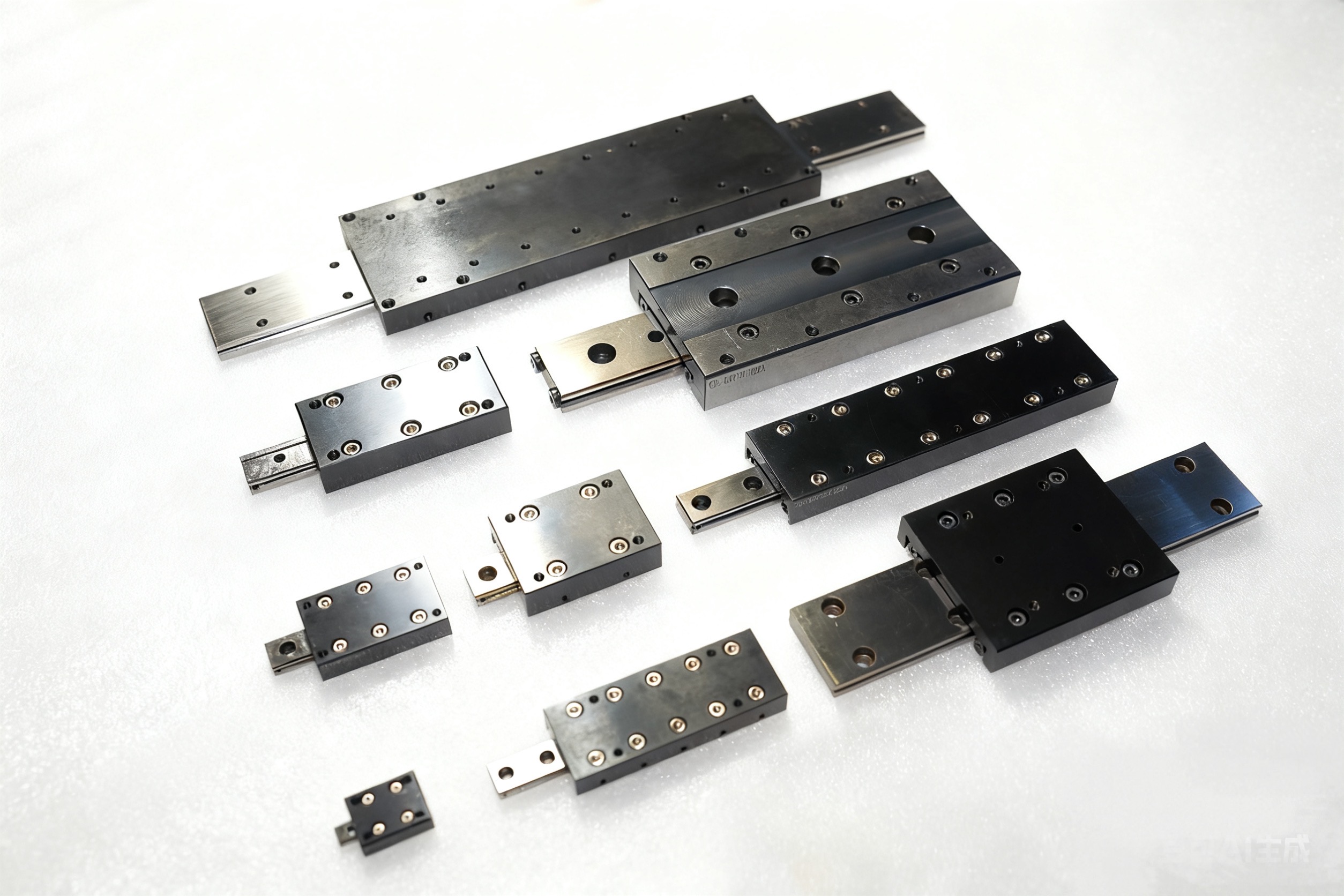
The pursuit of ultra-precision in modern manufacturing is a continuous battle against friction, deflection, and microscopic inaccuracies. In sub-micron applications like semiconductor wafer inspection, optical alignment, and high-precision laboratory automation, standard ball-bearing guides often reach their physical limits. When payloads become heavier, and tolerance windows shrink to the nanometer scale, engineers consistently turn to a specialized mechanical marvel: the Crossed Roller Table (often referred to as a crossed roller stage or linear motion slide).
To truly appreciate the engineering behind a crossed roller table, one must look at the contact mechanics inside the guide system. Traditional ball-bearing slides rely on point contact—the spherical balls touch the raceway at singular points. While this offers low initial friction, it creates a vulnerability under heavy loads, leading to elastic deformation and a phenomenon known as “brinelling,” where the balls dent the track over time. Crossed roller tables eliminate this flaw by utilizing cylindrical rollers as the rolling elements. Because a cylinder interacts with a V-grooved raceway via line contact, the load is distributed over a significantly larger surface area.
The genius of the system lies in how these rollers are arranged. Housed within a precision-machined cage, the cylindrical rollers are oriented at alternating 90-degree angles relative to each other. This crisscross pattern allows a single rail assembly to absorb loads and moments from all directions simultaneously—including radial, reverse-radial, and lateral forces. The result is a dramatic increase in load capacity and torsional rigidity. When mounted onto a dedicated working table or stage body, this mechanism creates a platform that feels incredibly rigid, resisting deflection even when subjected to overhanging or cantilevered loads.
However, high rigidity means nothing in precision engineering if it compromises smoothness. What makes the crossed roller table a masterpiece of mechanical design is its ability to deliver this extreme stiffness alongside an ultra-smooth, almost fluid motion profile. Because the rollers roll along ground V-ways with minimal friction, the stick-slip effect—the jerky motion that occurs when a slide transitions from a standstill to movement—is virtually eliminated. This enables incredibly minute, incremental steps, which is why these tables are indispensable in laser cutting, medical imaging devices, and micro-machining centers where even a micrometer of deviation can result in catastrophic product failure.
Of course, the performance of a crossed roller table is fundamentally tied to the quality of its internal components, particularly the roller cage (or retainer). A poorly designed cage allows the rollers to skew, causing a dramatic spike in friction and a phenomenon called “cage creep,” where the retainer shifts out of its optimal position over time. High-end manufacturers prevent this by employing advanced anti-creep mechanisms, such as integrated rack-and-pinion systems or specialized cage geometries that guide the rollers with absolute fidelity. Combined with premium materials and advanced surface treatments, these components ensure that the table maintains its sub-micron repeatability over millions of cycles, offering a prolonged operational lifespan that lowers the total cost of ownership for factory automation lines.
For system integrators, another major advantage of the crossed roller table is its high integration readiness. Unlike building a linear guide system from scratch—which requires meticulous alignment of individual rails, adjusting preloads, and verifying parallelism—a precision crossed roller table is delivered as a fully assembled, factory-preloaded module. This plug-and-play nature dramatically simplifies the machine-building process. Furthermore, the inherent design scalability allows manufacturers to offer customized, non-standard variations. Whether an application requires specific mounting hole patterns, specialized cleanroom-compatible lubricants, or corrosion-resistant stainless-steel bodies for harsh environments, these tables can be tailored to fit the exact spatial and environmental constraints of the machinery.
Ultimately, the crossed roller table represents the pinnacle of linear positioning technology. By successfully balancing the competing demands of high load capacity, absolute rigidity, and effortless smoothness, it provides the rock-solid foundation upon which high-tech industries build the future. As automation demands continue to evolve toward faster cycle times and tighter tolerances, this elegant mechanical solution remains irreplaceable, proving that sometimes, the key to unlocking advanced digital manufacturing lies in mastering the fundamentals of physical precision.